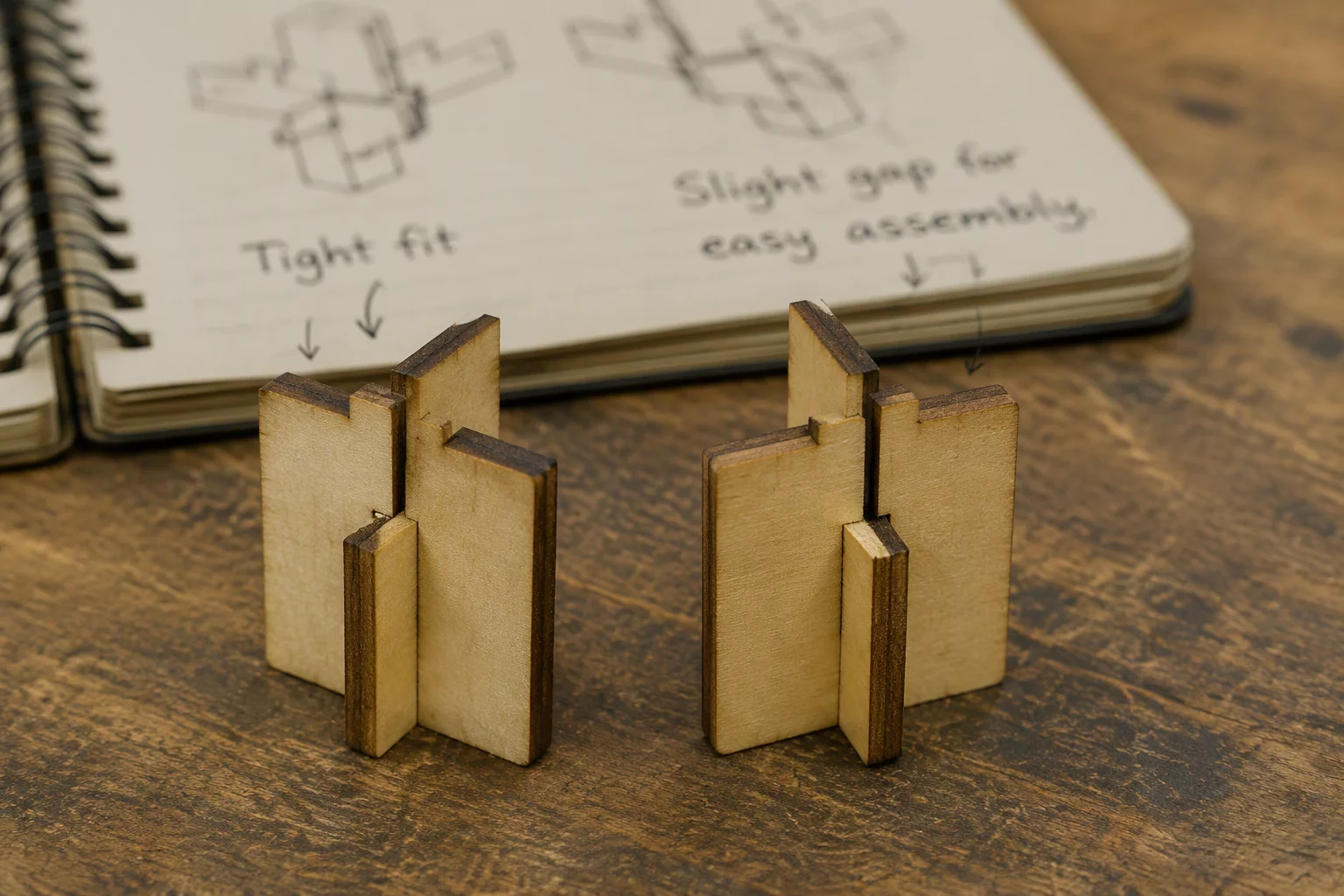
Friction Dynamics and Assembly Ergonomics
In flat-pack laser cutting and modular joinery, engineers continually navigate the boundary between high friction hold and user-friendly assembly. A tight interference fit eliminates the need for fasteners or adhesive bonds by leveraging the micro-compressibility of wood fibers or the tension of cast acrylic. However, excessive press interference increases insertion resistance, often leading to delamination across thin plywood veneers or localized fracture along brittle acrylic tabs.
Conversely, an easy-assembly geometry provides a clearance window between 0.05 mm and 0.12 mm around the joint perimeter. While this tolerance allows effortless mating by hand, it transfers mechanical rigidity to downstream fastenings or PVA adhesive film. Choosing the right offset depends heavily on the production volume, end-user tool availability, and ambient humidity fluctuations.
Explore our standardized test coupon sequence to dial in the exact beam offset for CO2 and fiber laser setups.
Empirical Tolerance Matrix: 0.00 mm to 0.25 mm Offsets
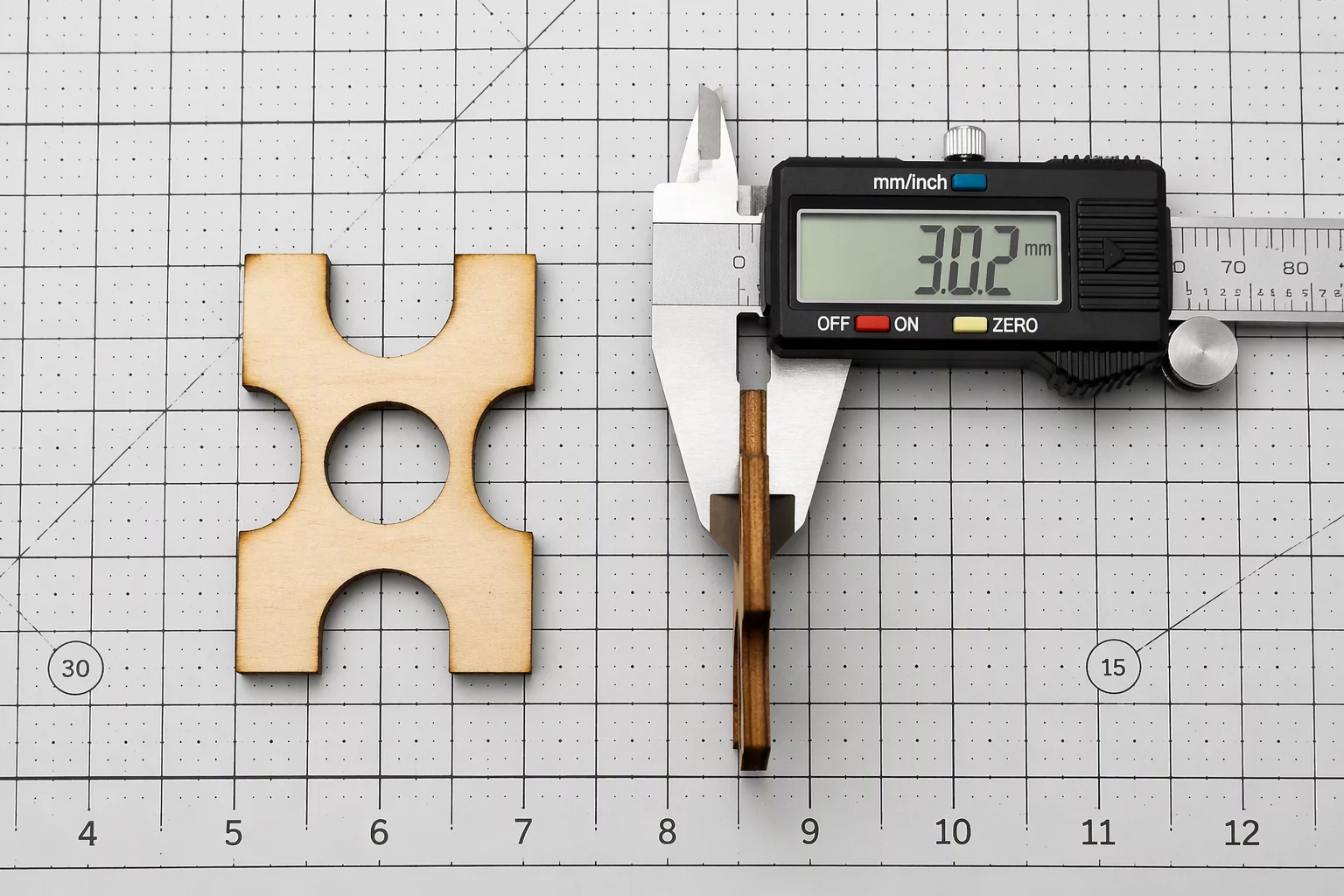
We evaluated five distinct slot offsets across 3.0 mm Baltic birch plywood and 3.0 mm cast PMMA sheets. Digital force gauge testing measured insertion loads during assembly alongside pull-out resistance after 72 hours of climate stabilization at 21 degrees Celsius and 45 percent relative humidity.
Laboratory Findings & Offset Recommendations
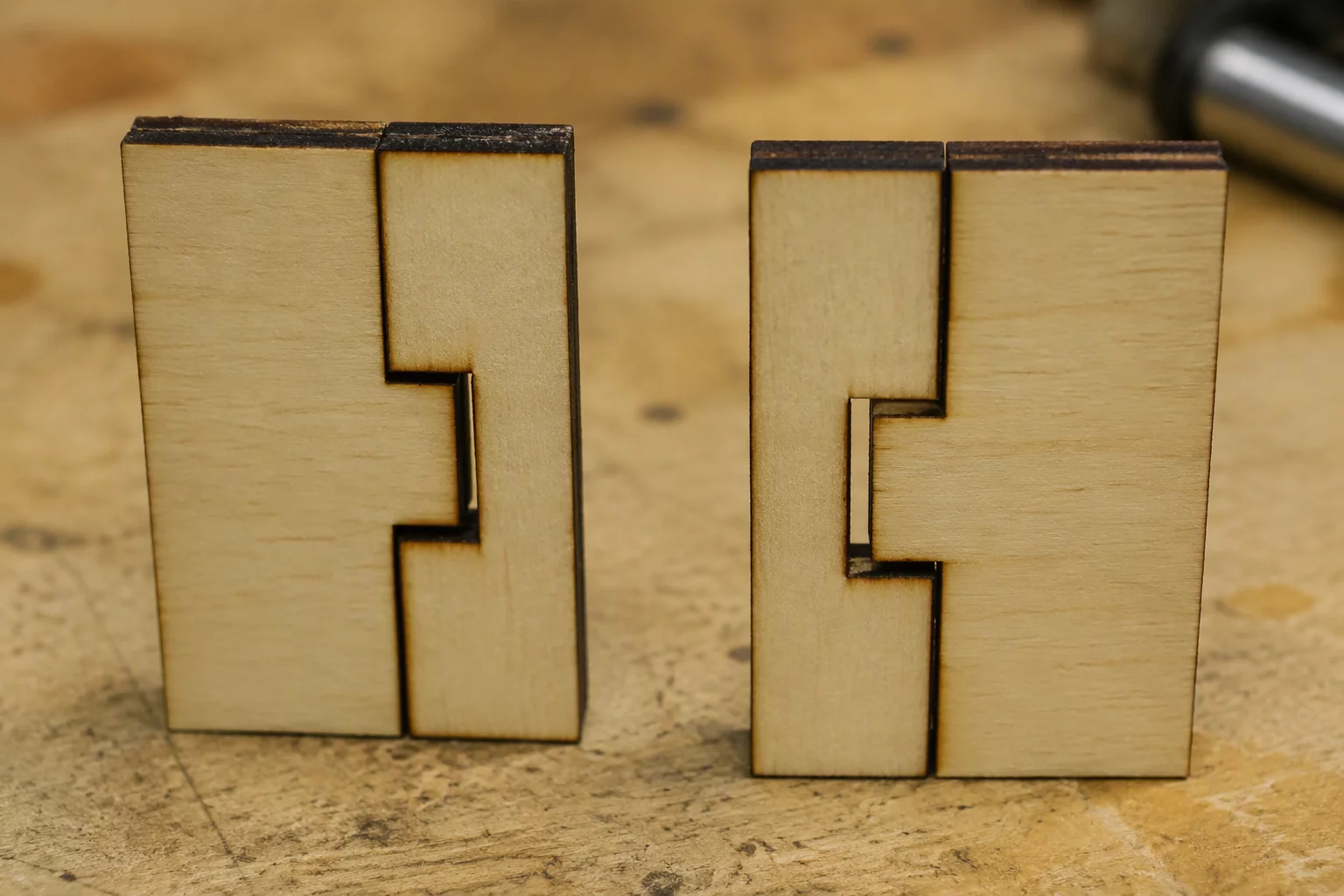
- 0.00 mm to +0.02 mm Offset: Produces a zero-play press fit requiring soft-mallet tapping; best suited for permanent plywood assemblies without glue.
- +0.05 mm to +0.08 mm Offset: Delivers a smooth sliding fit with positive tactile engagement; ideal for consumer kits assembled without tools.
- +0.12 mm to +0.20 mm Offset: Provides glue reservoir clearance; prevents dry wiping of adhesive when inserting deep cross-lap tabs.
Material Elasticity and Long-term Joint Retention
Cellular materials such as birch plywood and MDF possess internal compliance that accommodates up to 0.04 mm of local compression without structural degradation. Over repeated assembly cycles, however, the crushed surface cells lose restitution, steadily lowering the holding torque of unglued joints. Designers creating reusable modular fixtures should incorporate gentle lead-in chamfers or localized flexure tabs rather than relying solely on raw edge friction.
In contrast, non-porous thermoplastics like acrylic exhibit virtually zero compressive recovery. An interference greater than 0.02 mm creates internal tensile hoop stress, resulting in micro-crazing around internal corners within weeks. For acrylic designs, an easy slip fit accompanied by solvent welding or locking T-slot hardware offers superior long-term reliability.
Joint Fit & Kerf Offset Questions
Natural plywood expands across its thickness as ambient humidity rises. A joint cut to a snug slip fit in a dry workshop can become an immovable press fit when exposed to higher humidity, while an overly tight joint may buckle or crack along the outer veneer.
Easy assembly joints are essential for flat-pack consumer products, educational kits intended for children, painted components where friction scrapes finish coats, and assemblies using adhesives that require capillary gap flow.
Because laser cuts exhibit a subtle hourglass or V-shaped edge draft depending on lens focal length, the top of the slot is often marginally wider than the bottom. Setting your beam focus 1/3 into material thickness minimizes this slant and produces symmetrical contact faces.

Sarah Jenkins
Related Slot Tolerances
Technical Discussion
Peer Calibration NotesNo comments yet. Be the first to leave a technical observation or question below.
Leave a Technical Observation