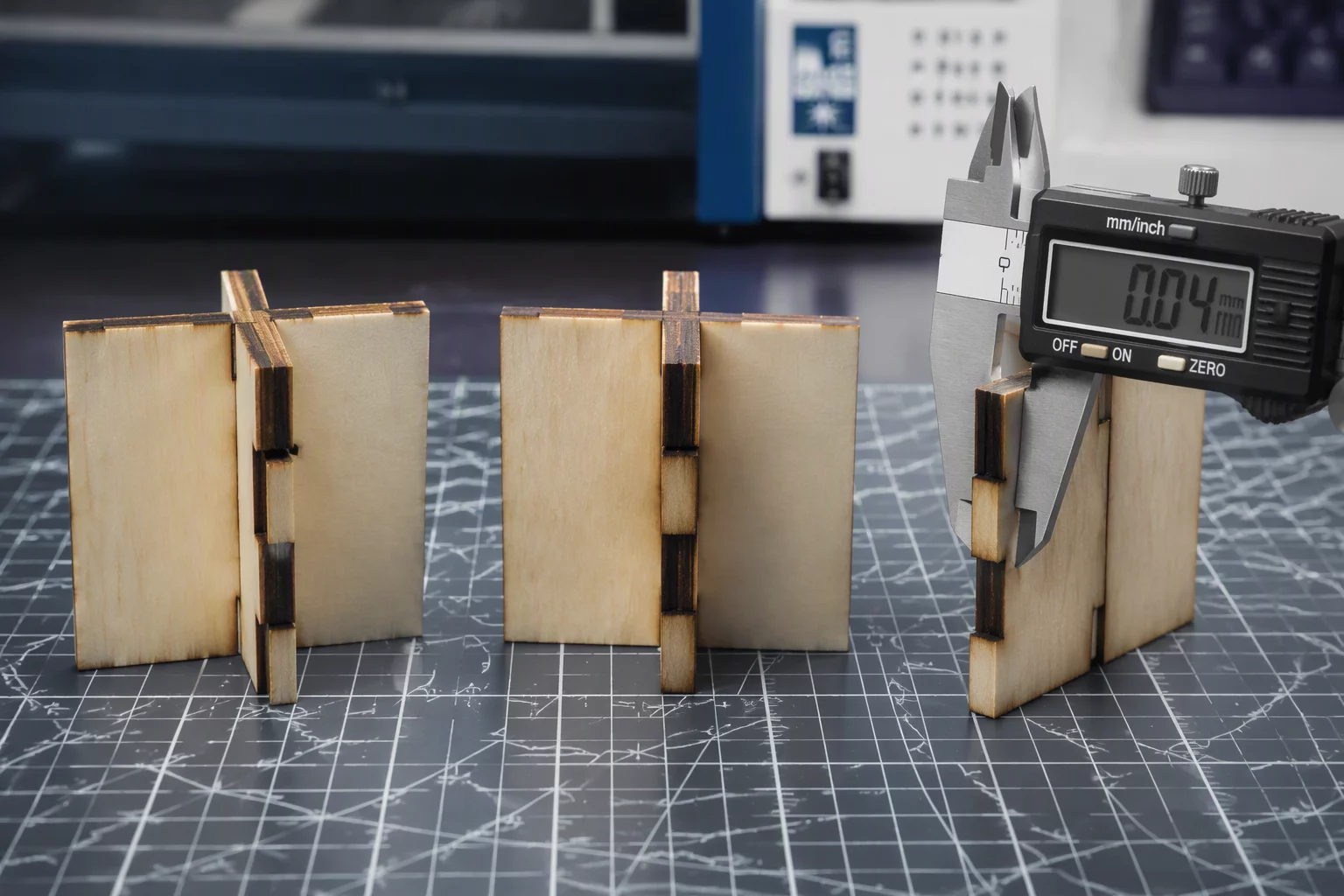
Evaluating Interlocking Resistance Under Varied Offsets
Laser cutting introduces an inherent beam width kerf that fundamentally dictates whether an interlocking tab and slot assembly stays securely bound by friction or falls apart upon handling. In this series of coupon runs, our laboratory tested seven incremental slot widths on 3.0 mm Baltic birch plywood and 3.0 mm cast acrylic to map the exact threshold between effortless assembly and destructive interference.
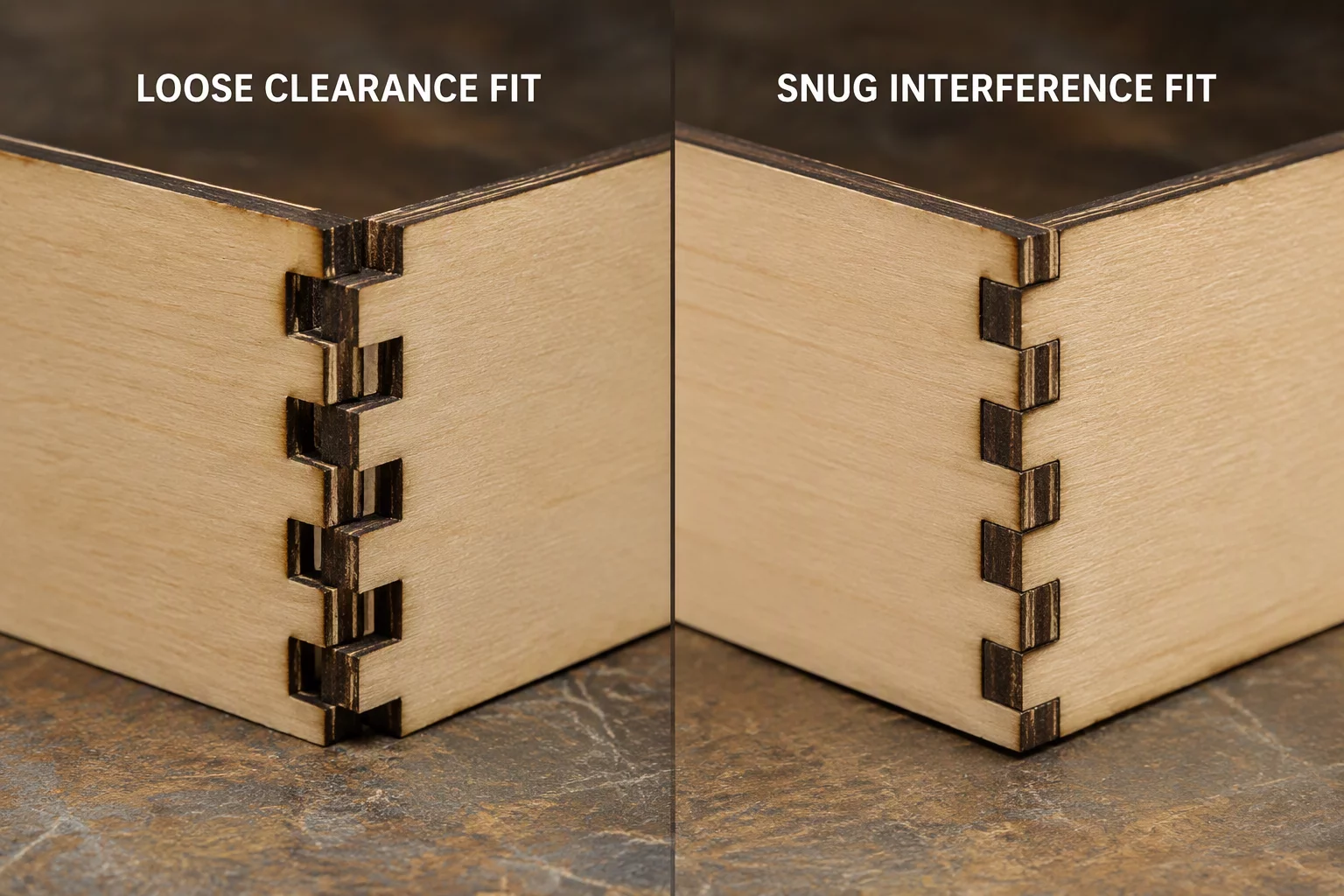
A calibrated digital force gauge pulled each mating tab along its insertion axis to record extraction resistance. While a 0.05 mm negative offset created a smooth slip-fit requiring less than 0.8 N of extraction force, reducing the slot clearance to an interference of 0.07 mm increased retention force to 28.4 N in birch plywood. The organic fibers yielded slightly, creating an exceptional friction bond without splitting the outer veneer layers.
Check our standardized cutting test coupons to calibrate beam width compensation in LightBurn before batch production.
Material Mechanics: Wood Fiber Compliance vs Acrylic Rigidity
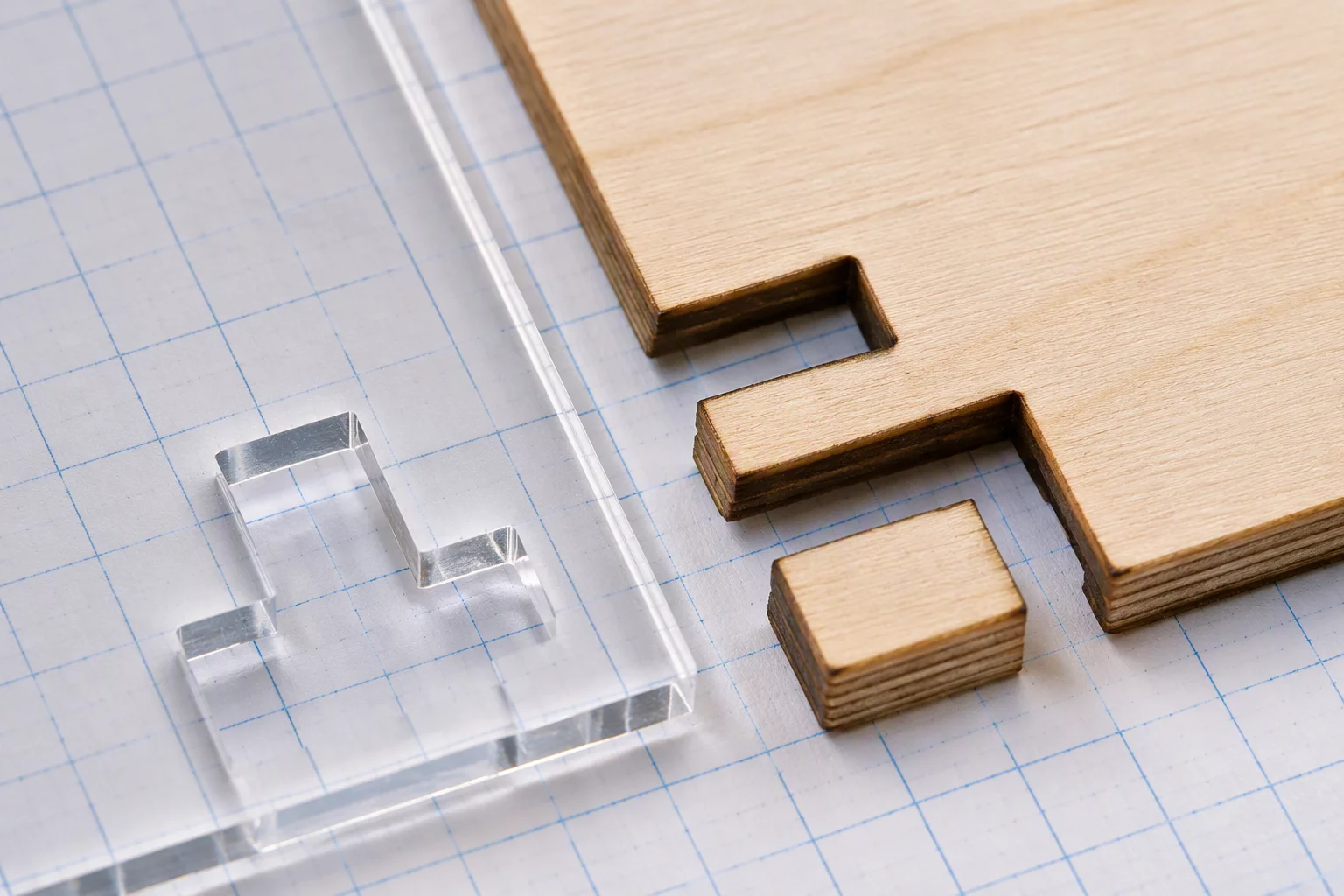
The mechanical response of the material dramatically alters the permissible friction envelope. Plywood exhibits internal compressibility, permitting small assembly over-tolerances where the wood fibers deflect during insertion. Acrylic behaves in complete contrast; its rigid polymer structure cannot compress, meaning an interference offset exceeding 0.03 mm induces micro-cracking and localized stress fractures along internal corner radiuses.
Key Friction Test Observations
- Plywood accommodates 0.06 mm to 0.09 mm interference for permanent glue-free joinery.
- Cast acrylic requires a tight line-to-line fit (0.00 mm to +0.02 mm clearance) to prevent corner shear failure.
- Laser focus depth directly controls edge taper, which alters friction along the slot depth by up to 35%.
Design Adjustments for Predictable Friction Fits
To guarantee reliable friction without demanding unrealistic cutting tolerances, incorporating subtle compliance features into the vector design provides exceptional consistency. Adding miniature lead-in chamfers of 0.3 mm on tab corners prevents veneer tear-out upon initial alignment, while integrating a micro-crush rib along one internal slot edge allows consistent press-fit resistance even when batch material thickness varies by up to 0.15 mm.
When designing enclosures intended for repeated disassembly, relying purely on heavy interference leads to premature wear and loosened joints after three to four cycles. Designing spring-loaded relief cutouts or utilizing shallow retention detents maintains constant holding power across dozens of insertion cycles without material degradation.
Friction Testing & Tolerances FAQ
For standard 3 mm birch plywood on a clean CO2 laser, a kerf offset between +0.06 mm and +0.08 mm delivers a solid hand-press joint that holds its own weight without requiring adhesive.
High interference crushes the surface fibers permanently on the first insertion. For reusable joints, reduce interference to +0.02 mm and add small vector spring tabs rather than relying on raw wood compression.
Higher cutting speeds minimize excessive heat bloom and reduce taper angle, resulting in parallel slot walls that maximize surface-to-surface friction contact throughout the full material thickness.

David Wright
Related Slot Tolerances
Technical Discussion
Peer Calibration NotesNo comments yet. Be the first to share your laboratory test observation.
Leave a Technical Observation