Elastic Compliance Versus Rigid Brittle Tolerances
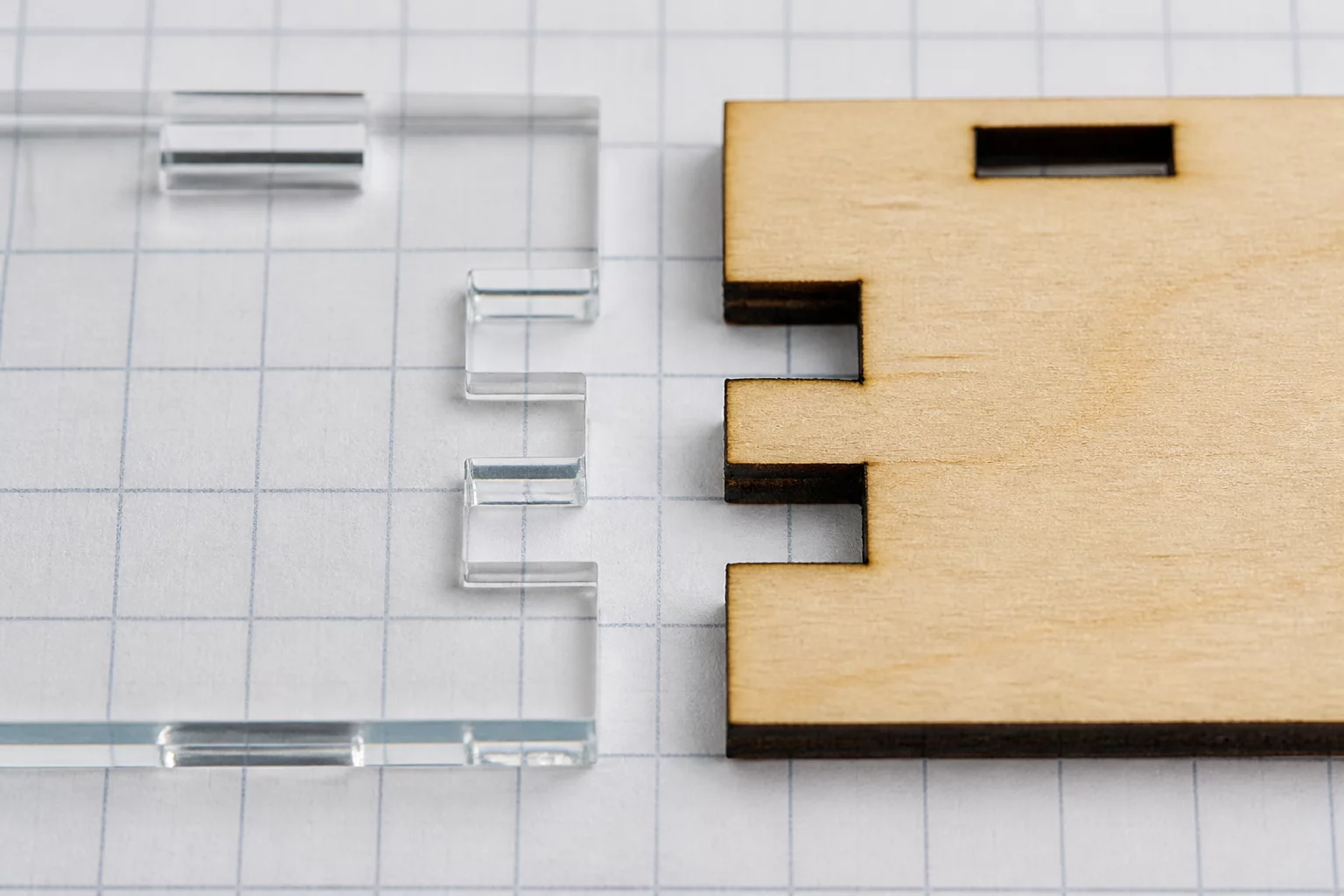
When testing interlocking slot joints on a CO2 laser cutter, material composition dictates mechanical interaction far more than nominal dimensional ratings indicate. Birch plywood features fibrous lignin networks that compress slightly during assembly, forgiving minor cut width undersizing by 0.04 mm to 0.08 mm. In contrast, cast and extruded polymethyl methacrylate (acrylic) exhibits zero fibrous spring, meaning an interference fit of merely 0.03 mm will either induce immediate stress crazing or crack the mating flange entirely.
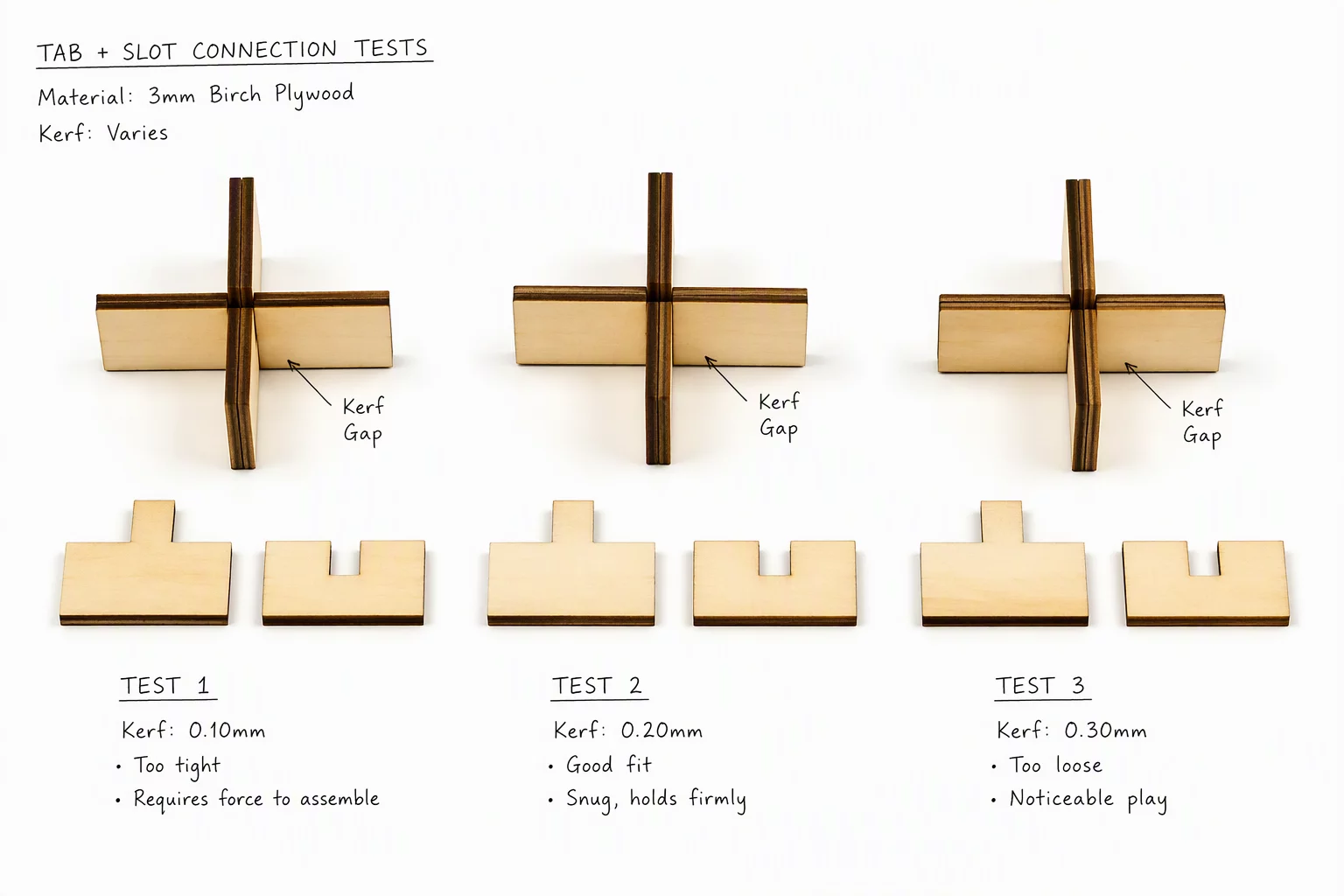
In our laboratory bench tests using a 50 mm calibration coupon matrix, 3.0 mm nominal cast acrylic required an exact cut width clearance of +0.02 mm above measured caliper thickness to assemble smoothly without binding. Meanwhile, 3.0 mm Baltic birch plywood achieved a snug friction lock when cut exactly to caliper width, relying on edge grain friction and micro-compression to hold the perpendicular tabs firmly in place.
Learn how to apply outer and inner contour kerf compensation to eliminate brittle failure in acrylic joints.
Edge Quality, Thermal Melt, and Friction Behavior
Laser cutting acrylic involves pure vaporisation and thermal melting, producing a flame-polished, glassy edge profile with a subtle draft angle. This polished contact face reduces sliding friction significantly, requiring interlocking geometries to utilize mechanical detents or tighter tab limits. Conversely, laser cutting plywood chars cellular wood fibers, resulting in a microscopic serrated texture that produces higher static friction and self-locking capabilities even with looser nominal fits.
Key Experimental Takeaways
- Acrylic joints require intentional clearance (+0.02 mm to +0.04 mm) or dogbone stress reliefs to prevent radial cracking under press-fit loads.
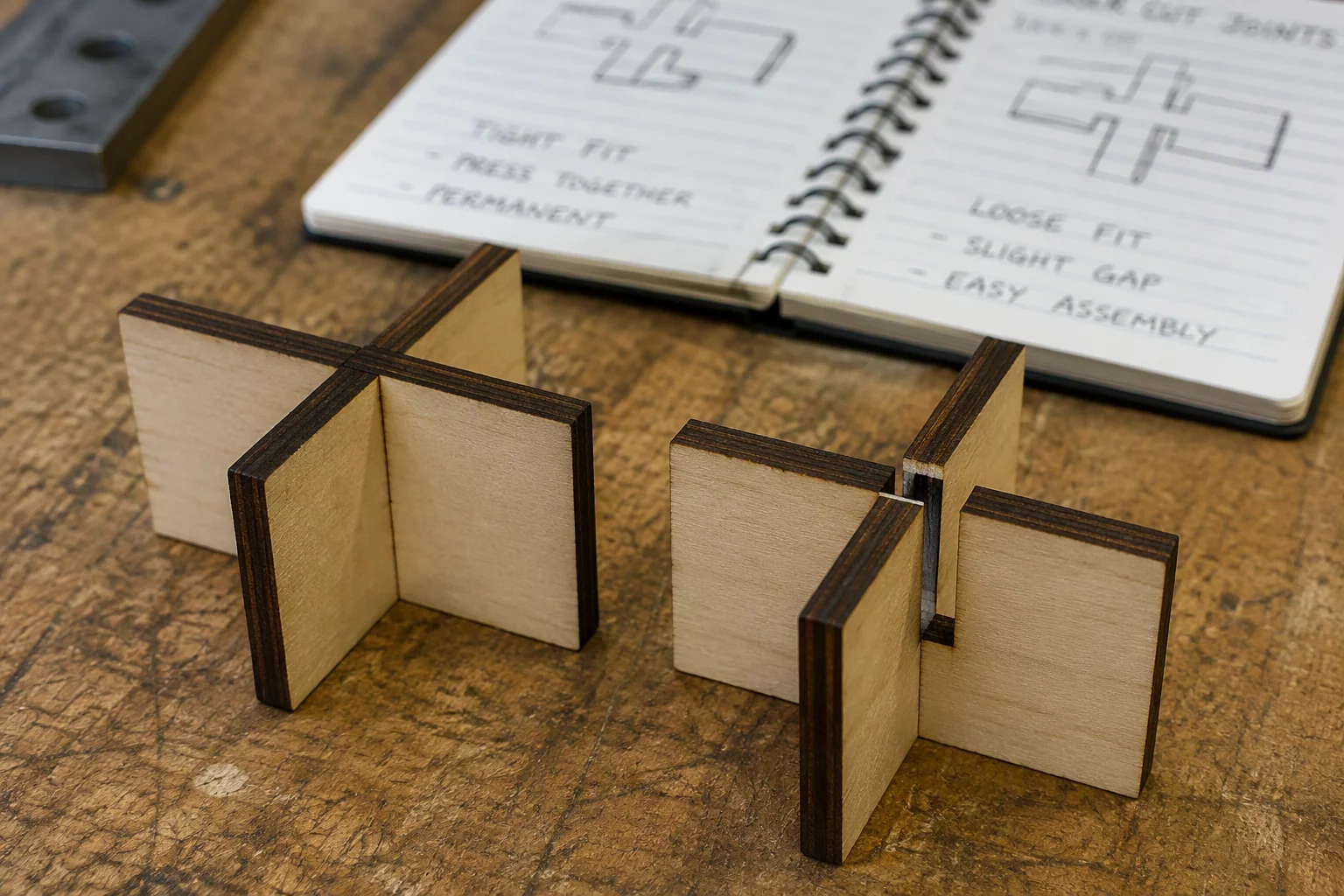
- Plywood absorbs minor interference (-0.03 mm to -0.06 mm) through fiber compression, providing robust friction joints without adhesive.
- Sheet thickness variance across cast acrylic sheets can reach +/-10%, demanding caliper verification on every new workpiece corner.
Caliper Verification and Kerf Offset Strategies
Because sheet thickness varies across cast acrylic sheets, applying a static universal kerf offset in your CAD or LightBurn layout frequently leads to split tabs or wobbly structures. We recommend measuring material thickness across multiple points on the actual stock sheet using digital calipers before dialing in your cut offset. For plywood, prioritize slot depth allowances that accommodate localized core ply voids.
When designing hybrid assemblies where acrylic tabs insert into plywood base plates, always calibrate the slot width to match the rigid acrylic's maximum measured thickness plus kerf width, relying on the softer plywood frame to absorb the seating forces without fracturing the plastic component.
Frequently Asked Fit Questions
Acrylic possesses high tensile stiffness but very low yield elongation. If a slot is undersized even by 0.05 mm, the press force generates concentrated hoop stress at sharp internal corners, causing immediate crack propagation. Always radius inner corners or use an exact sliding fit.
Yes. Slower speeds in acrylic create excessive thermal melting, which widens the kerf and creates a pronounced conical edge bevel. In plywood, slower speeds create deeper charring and soot formation without excessive edge flow.
Solvent welding (such as with acrylic cement) or mechanical retaining tabs are strongly recommended for acrylic. Relying purely on interference friction creates long-term residual stress that leads to spontaneous stress crazing over time.

Sarah Jenkins
Related Slot Tolerances
Technical Discussion
Peer Calibration NotesMorgan
Fabrication TechnicianAcrylic is so unforgiving compared to plywood. Thanks for the notes.
Leave a Technical Observation