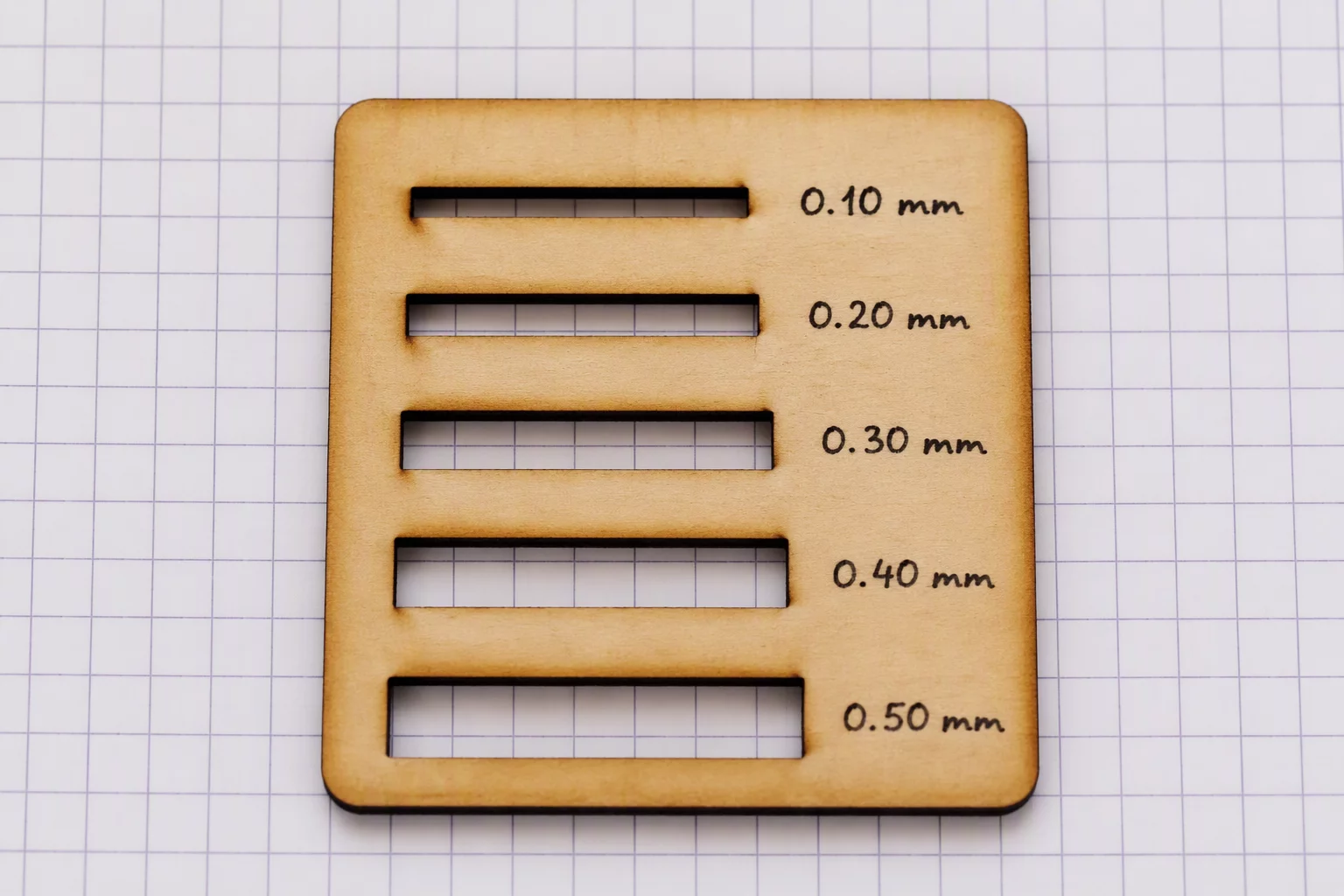
The Goal of the Five-Step Slot Matrix
Standard nominal thicknesses on sheet goods rarely tell the complete story during precision assembly. When drafting a slotted interlocking box or structural rib, assuming a nominal 3.00 mm slot will fit nominal 3.00 mm plywood overlooks removed material and actual sheet thickness. In this illustrative case, the test coupon carries five deliberate slot widths ranging from 2.85 mm up to 3.05 mm in discrete 0.05 mm increments.
By testing one insertion tab against five adjacent slot geometries cut in the exact same laser pass on the same sheet, we isolate dimensional tolerance from power fluctuations and focal drift. This empirical benchmark clarifies the precise threshold where clearance fit transitions into sliding friction, ideal interference, and over-tight binding.
Review the systematic calibration sequence used to measure beam kerf, focal depth variations, and material density compensation.
Tolerance Intervals and Empirical Results
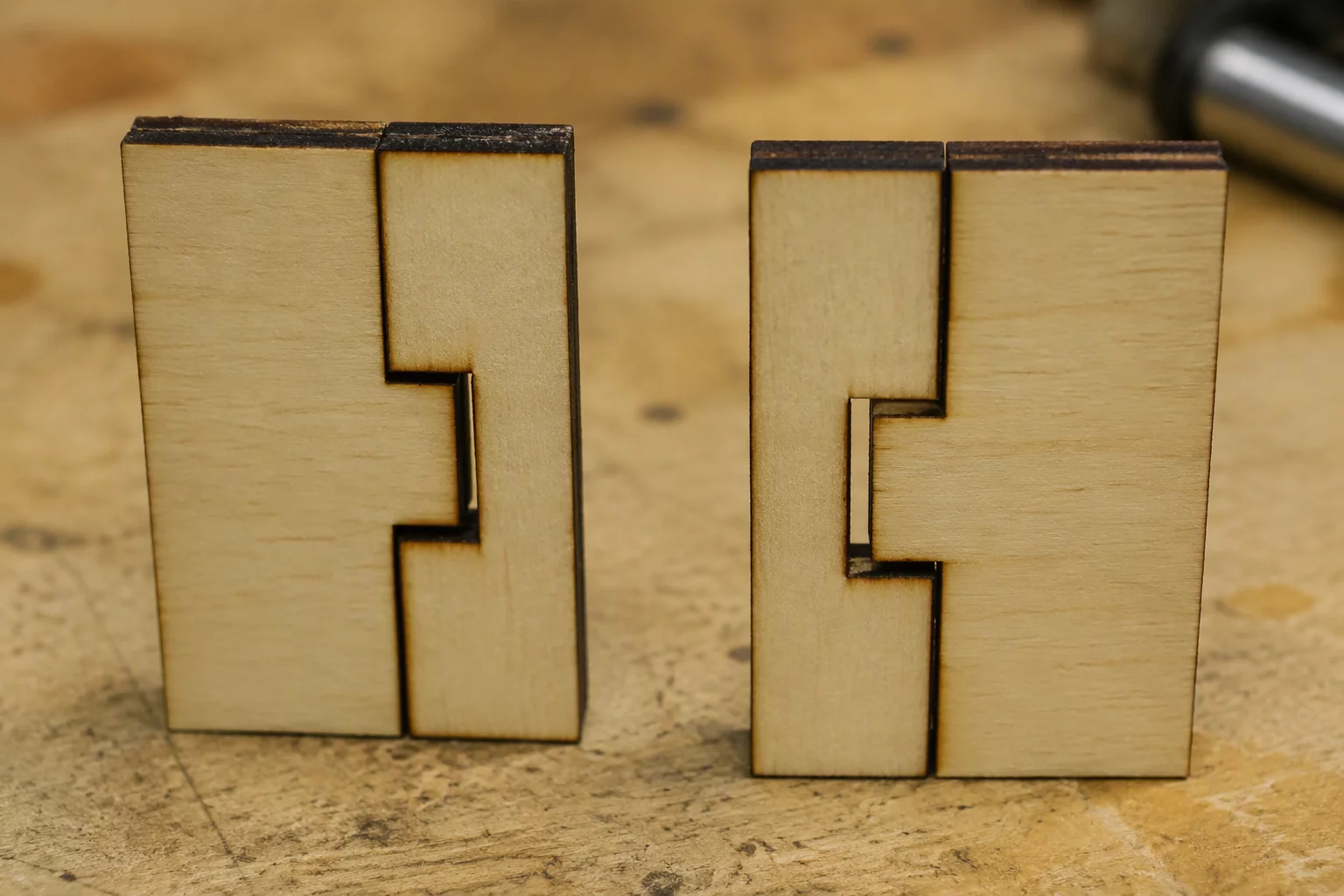
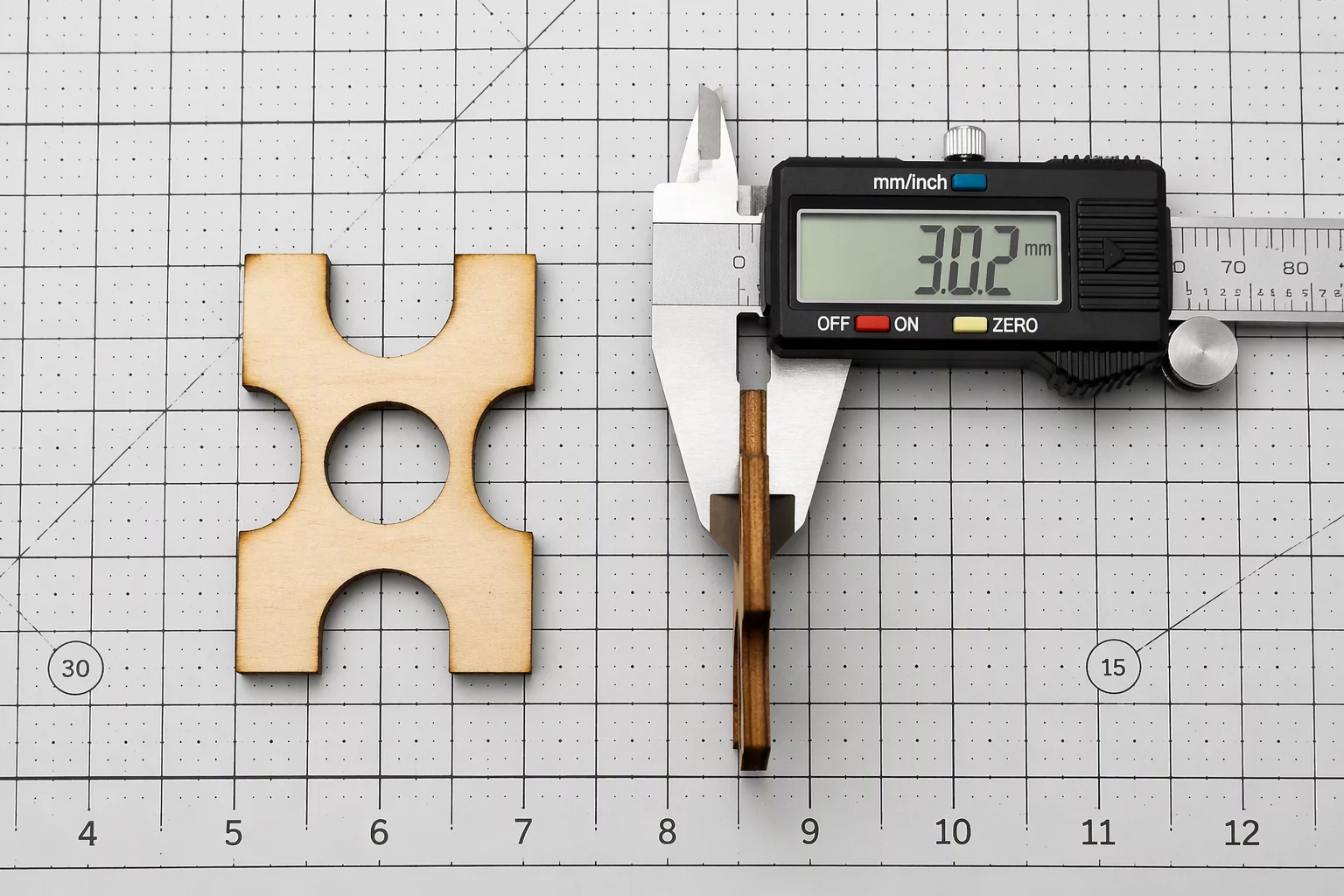
The illustrative observations below compare five intended slot widths with one mating part, recorded as 2.94 mm thick for this example. These values do not prescribe a setup for your material. At 2.85 mm, the slot required excessive force that caused delamination of the outer birch ply veneer. At 2.90 mm, the example records a tight press fit with high insertion force. At 2.95 mm, a firm friction fit allowed smooth manual push assembly without tools. The 3.00 mm slot provided a slip fit with detectable lateral play, while 3.05 mm resulted in a loose gap unsuitable for unglued joinery.
Key Calibration Takeaways
- In this illustrative case the measured mating thickness was 2.94 mm. The 2.95 mm candidate allowed hand assembly; repeat that coupon before selecting a joint width.
- A 0.05 mm step size is the ideal resolution for testing wood tolerances, capturing the transition zone between slip and press fits.
- Laser kerf removed approximately 0.12 mm of total material across slot boundaries under 20 mm/s cutting speeds at 45% power.
Applying Width Stepping in LightBurn Projects
Rather than modifying base CAD geometry across hundreds of tenons in a complex enclosure design, the empirical five-step test coupon allows rapid identification of the ideal inner/outer kerf compensation value directly in LightBurn layer settings. Record a candidate offset as a hypothesis, inspect its path in Preview, and compare a new coupon with the baseline before applying it to the enclosure.
We recommend cutting this five-slot coupon before starting any production batch on freshly delivered wood sheets. Documenting the date, caliper thickness, and preferred slot index in your fabrication log eliminates guesswork and prevents wasted full-sheet runs.
Frequently Asked Questions
Theoretical calculations often overlook wood density compression, localized moisture expansion, and slight focal taper along the cut edge. Physical insertion testing verifies actual mechanical friction that math alone cannot predict.
For temporary or display assemblies that get dismantled regularly, a neutral slide fit with 0.02 mm to 0.04 mm clearance prevents surface wear and wood splintering over repeated cycles.
Cast acrylic lacks the natural elasticity of wood fibers, so an interference fit that works in plywood may crack acrylic. Acrylic generally requires 0.03 mm wider slots than plywood under identical nominal thickness.

James Miller
Related Slot Tolerances
Technical Discussion
Peer Calibration NotesAlex
Workshop FabricatorGreat visual comparison of the five widths. Helped me understand the tolerance better.
Leave a Technical Observation