Fiber Density and Resin Core Thermal Dynamics
Medium-density fiberboard (MDF) behaves fundamentally differently under a focused CO2 laser beam compared to natural hardwoods or layered birch plywood. Because MDF consists of highly compressed wood fibers bonded with urea-formaldehyde or polymeric binders, the optical beam encounters a uniform physical density without alternating grain rings. However, the organic binder reacts aggressively to concentrated thermal energy, releasing localized vapor plumes and micro-charring along the cut line that widens the final kerf beyond optical calculations.
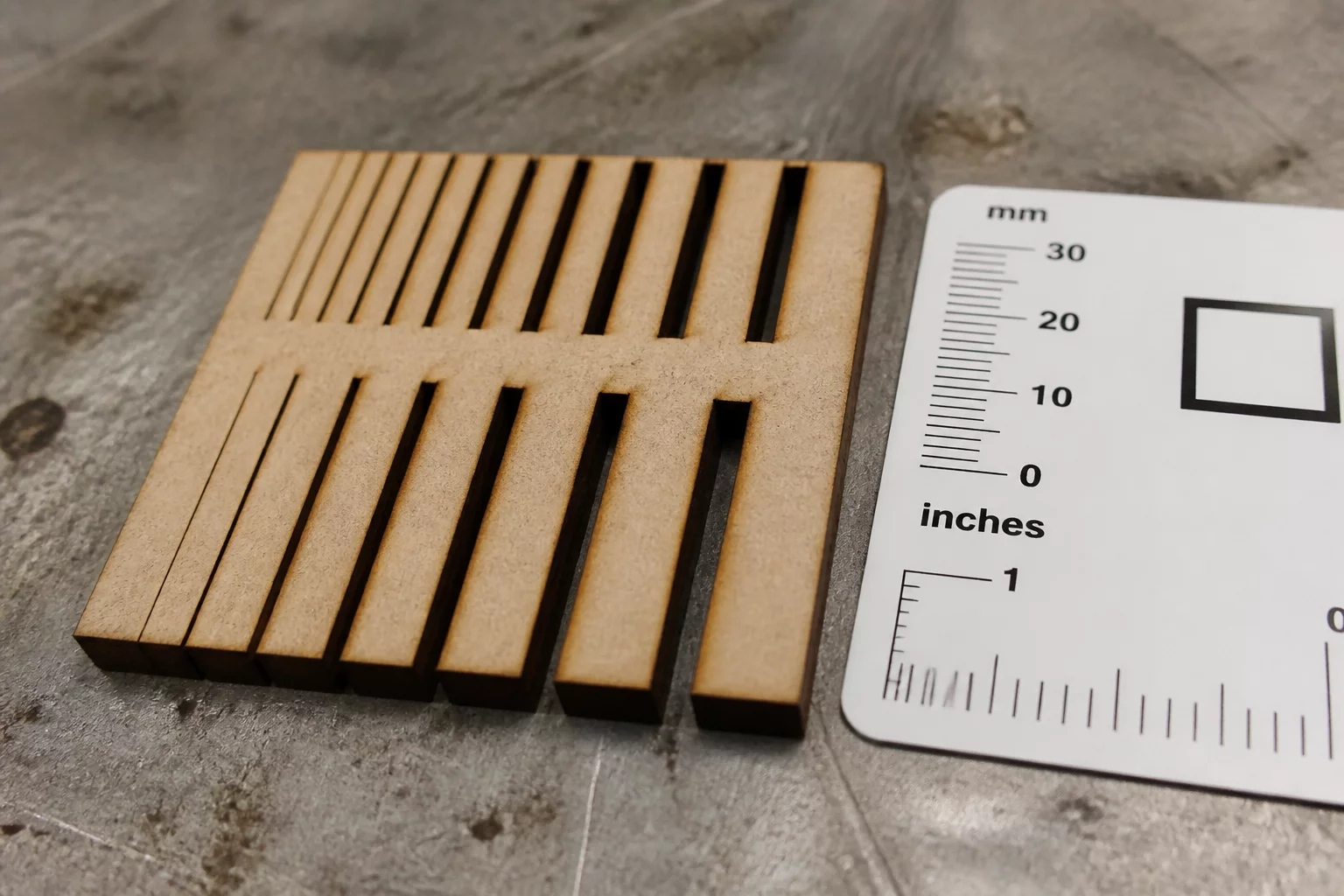
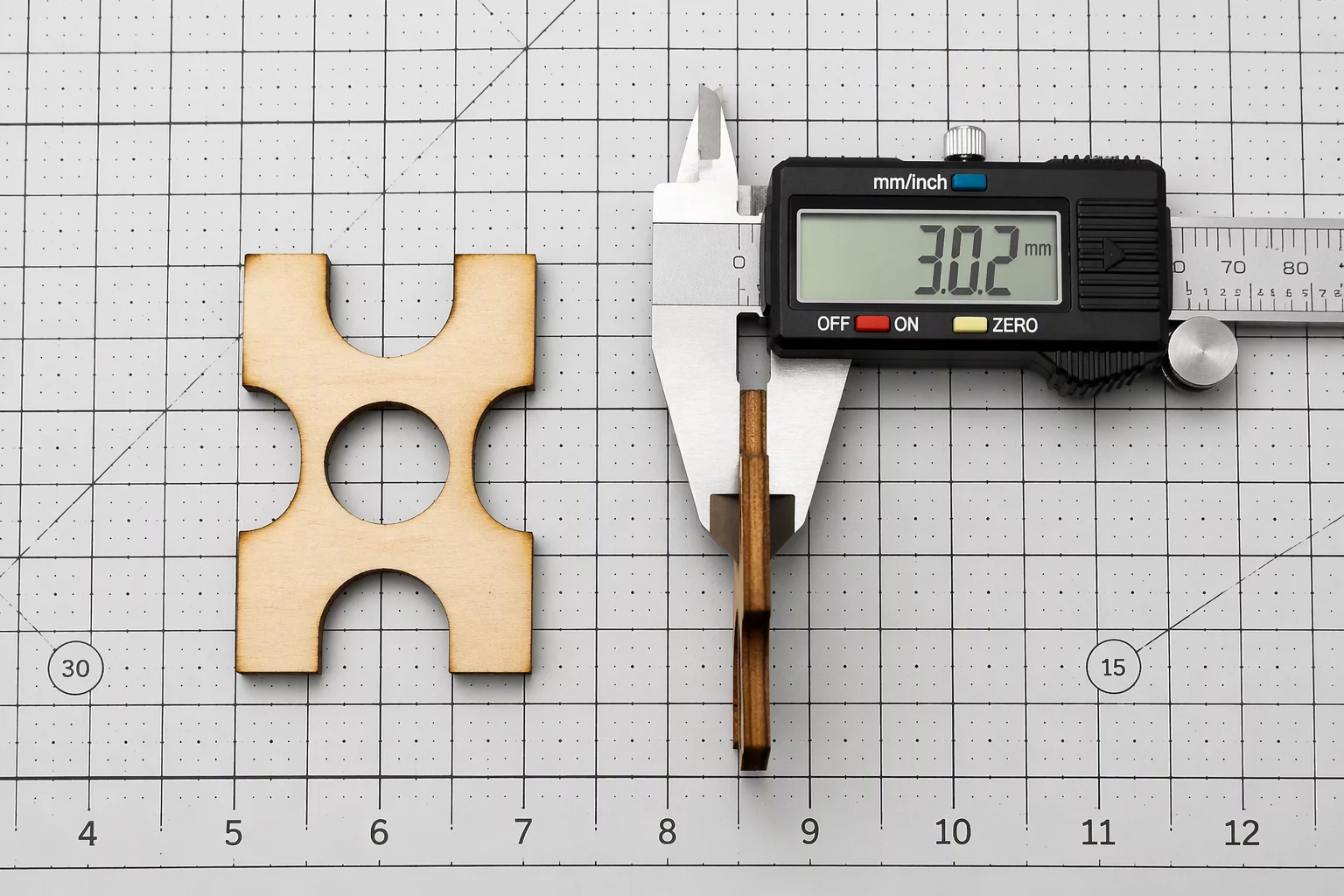
In our standardized multi-coupon test array, 3.0 mm and 6.0 mm standard MDF panels from three distinct manufacturers were processed using a 60W CO2 laser at calibrated cutting speeds between 12 mm/s and 24 mm/s. Across all test runs, the effective kerf measured consistently between 0.18 mm and 0.23 mm, which is roughly 20% wider than identical geometry cut into cast acrylic under equivalent energy density.
Explore our standardized multi-slot coupon procedures for calculating exact kerf offset values across your own workshop inventory.
Key Kerf Metrics Across Standard Sheet Thicknesses
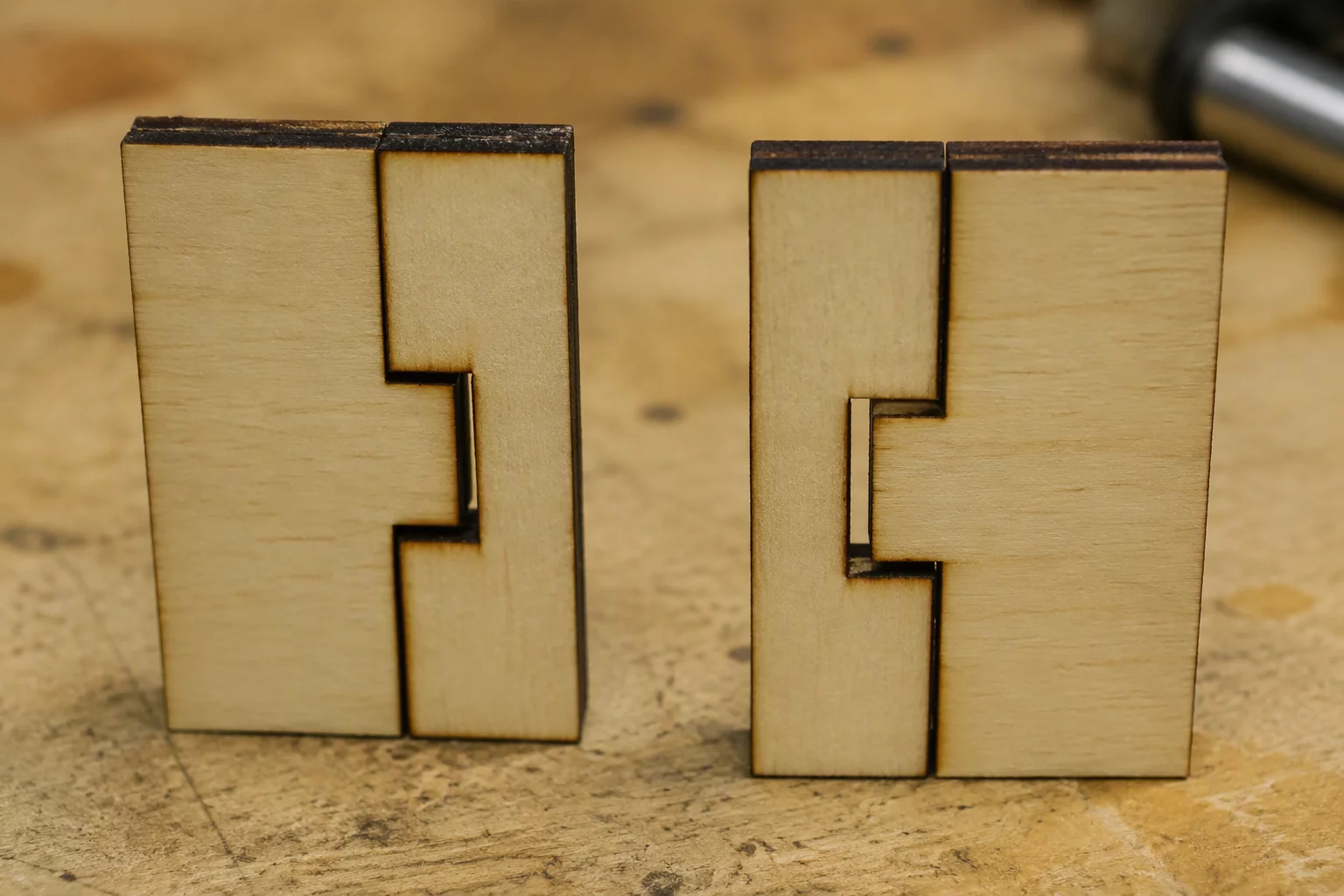
When designing friction-fit joinery such as finger joints, mortise-and-tenon connections, or interlocking grid dividers, assuming an arbitrary 0.15 mm kerf compensation inevitably results in loose, sloppy assemblies in MDF. As the laser cuts deeper through a 6.0 mm panel, beam divergence and reduced travel speed compound sidewall heat exposure, creating a subtle hourglass cross-section.
Key Experimental Findings
- Standard 3.0 mm MDF exhibits a stable 0.19 mm slot kerf when cut at 18 mm/s with 45% power and 1.8 bar coaxial air assist.
- 6.0 mm MDF requires an expanded 0.22 mm kerf allowance due to thermal dwell time in the lower resin-dense core layers.
- Moisture-resistant (green core) MDF yields 0.02 mm tighter kerfs than raw standard board under identical optical settings.
Joint Tightness and Assembly Repeatability in Production
The porous, compressed edge of laser-cut MDF lacks the natural elasticity and springback of layered plywood veneers. When an interference tab is forced into an undersized slot, microscopic fiber crushing occurs instantly, permanently degrading friction on subsequent insertions. For durable dry-fit assemblies, applying an inward kerf offset of exactly 0.095 mm per edge produces a snug sliding fit that withstands repeated assembly cycles without edge delamination.
Maintaining steady, clean air assist pressure is vital during fiberboard cutting. Without adequate airflow through the nozzle, combustible carbonized gases linger inside the cut channel, scattering the incoming laser beam and causing irregular kerf flare-ups near acute interior corners.
Frequently Asked Questions
MDF contains synthetic resin binders that vaporize and char beyond the optical focal waist. This secondary thermal ablation expands the kerf by 0.03 mm to 0.06 mm compared to non-resin composites.
Yes. The paraffin wax emulsions and denser resin systems in MR MDF reduce thermal burn-back, requiring approximately 0.02 mm less kerf offset than standard untreated boards.
We recommend a steady 1.5 to 2.0 bar (20–30 psi) clean, dry air assist stream to rapidly evacuate combustible vapors before peripheral charring widens the slot.

David Wright
Related Slot Tolerances
Technical Discussion
Peer Calibration NotesLeave a Technical Observation