The Mechanics of Lattice Slits and Beam Width
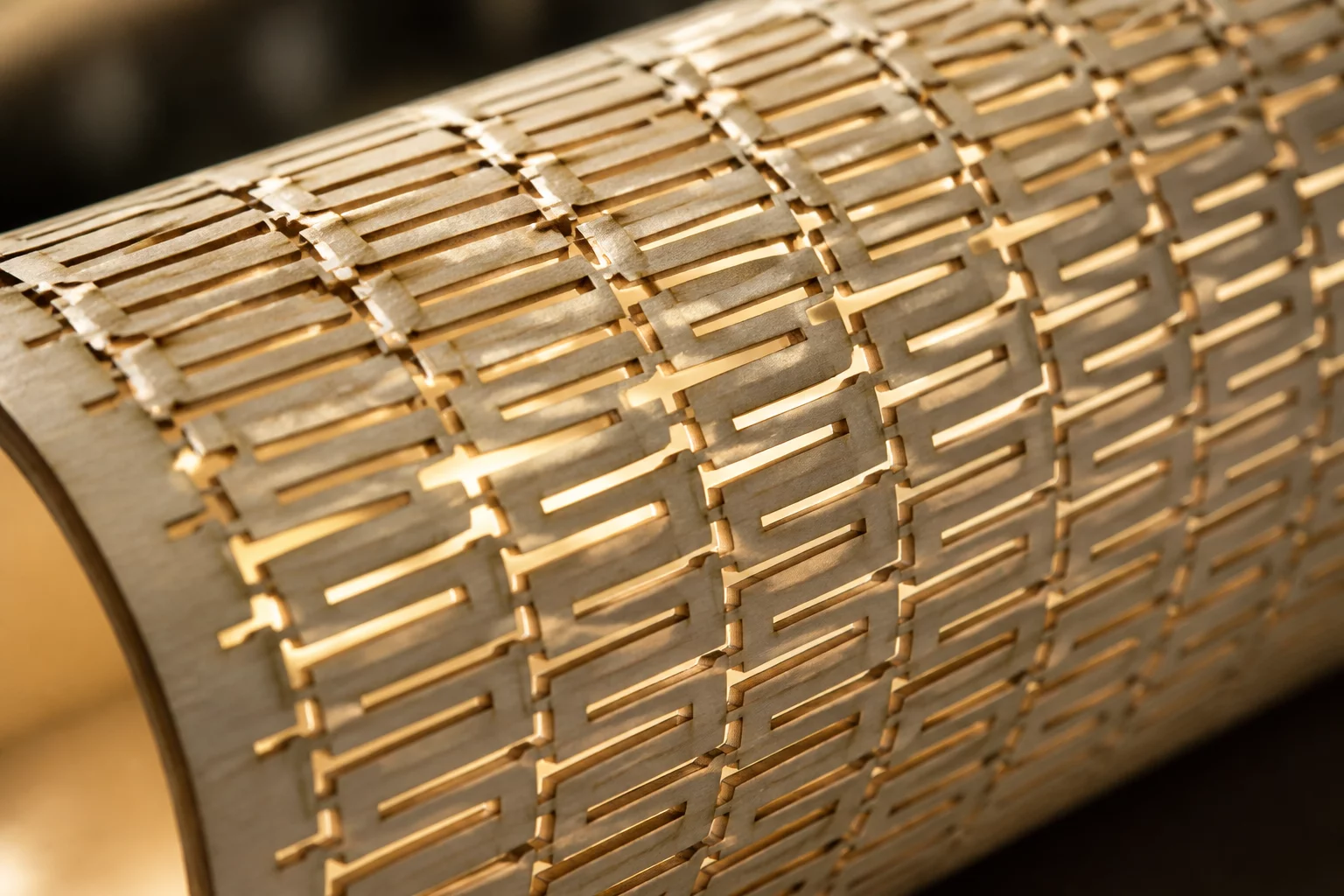
Creating a flexible living hinge from rigid sheet materials such as 3 mm birch plywood or MDF relies entirely on alternating cut patterns that redistribute torsional stress. However, many digital files treat cut lines as zero-width vectors. In practical laser processing, every pass of the focused beam vaporizes material, removing a kerf gap ranging from 0.12 mm to 0.24 mm depending on the lens focal length and travel speed.
When slit intervals are spaced closely, this thermal erosion significantly narrows the connecting bridges (the uncut webs of wood holding the hinge together). A planned web of 1.20 mm can degrade into a fragile 0.85 mm strip under heavy beam kerf. That loss drastically weakens the structural yield point, leading to catastrophic failure during the initial 90-degree bend.
Explore our complete parameter matrix for kerf compensation across diverse sheet thicknesses.
Torsional Stress vs. Kerf Offsets in Baltic Birch
During laboratory coupon trials on 3.15 mm Baltic birch sheets, we tested standard straight-lattice, wavy, and diamond patterns under controlled bending radii of 15 mm, 25 mm, and 40 mm. Adjusting the inner kerf offset in LightBurn permitted the effective bridge width to maintain structural integrity under continuous cycle tests. Increasing the gap between cut columns from 1.5 mm to 2.2 mm restored the necessary material volume to endure repeated flexure without splintering along outer grain layers.
Key Experimental Takeaways
- Slit line spacing must account for double-sided kerf erosion to prevent web failure.
- Orienting the primary cut slits perpendicular to the outer wood grain prevents inter-ply shear splits.
- Maintaining a minimum bridge width of 1.4 mm delivers maximum flexural durability in 3 mm birch.
Recommended Applications and Target Audiences
Fine-tuning living hinge cut clearances is essential for industrial product designers building curved enclosures, architectural scale modelers crafting organic façades, and makers fabricating seamless wood book covers or bespoke packaging. These precise geometry offsets eliminate the trial-and-error cycle that ruins valuable sheets of timber or cast acrylic.
For production workshops, applying calibrated kerf offsets directly in layer cut settings ensures repeatable yields across distinct material batches. Wood moisture shifts and seasonal veneer variances can alter the bend radius, making standardized test coupons indispensable before initiating high-volume nested runs.
Frequently Asked Calibration Inquiries
Wider kerfs remove more material inside the slit gap, allowing adjacent segments more clearance to tilt without colliding. However, excessive kerf narrows the remaining connecting bridge webs, making the assembly prone to snapping under sudden tension.
Yes. Cutting living hinge slits parallel to the surface grain frequently causes immediate delamination along wood fibers. Running hinge cuts perpendicular to the outer grain distributes tensile load across the cross-laminated internal veneer plies for superior resilience.
Cast acrylic lacks fibrous grain and has high notch sensitivity. While wood absorbs microscopic stress risers, laser-cut acrylic hinges develop micro-cracks at sharp cut corners. Acrylic hinges require wider web bridges and radiused slit ends or gentle thermal post-heating to flex safely.

Sarah Jenkins
Related Slot Tolerances
Technical Discussion
Peer Calibration NotesNo technical comments yet. Be the first to submit a test observation for this case.
Leave a Technical Observation