Dynamic Focus Shift in Warped Timber Substrates
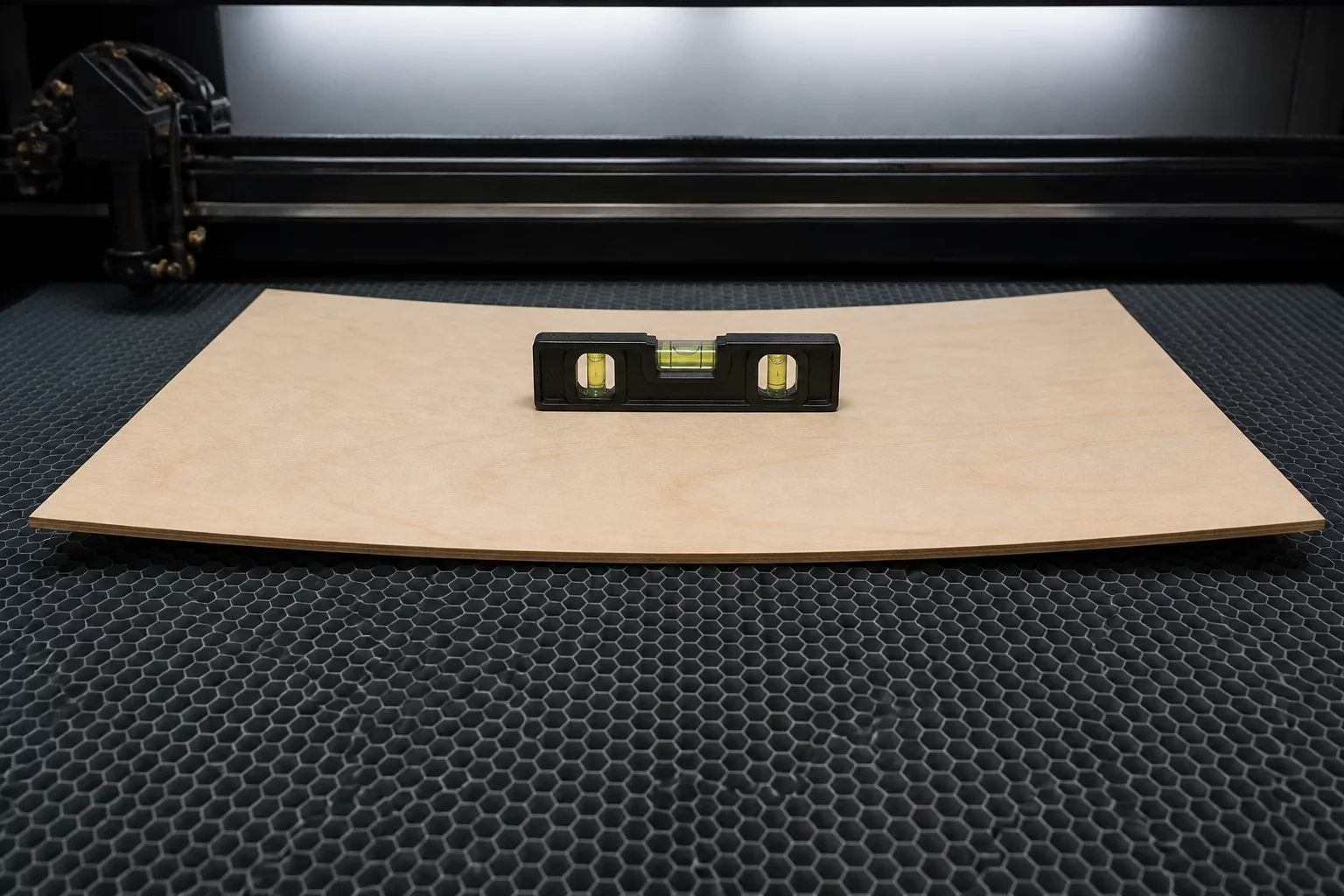
Natural wood veneers and composite fiberboards constantly exchange water molecules with the surrounding ambient air. An increase in relative humidity from 35% to 70% swells standard birch plywood by up to 4.2% across its thickness while creating subtle concave or convex cupping across full-format sheets. On flat laser beds, a vertical displacement of barely 1.2 mm shifts the beam's focal waist entirely outside the core layer, expanding the effective kerf width by over 30% on raised sections.
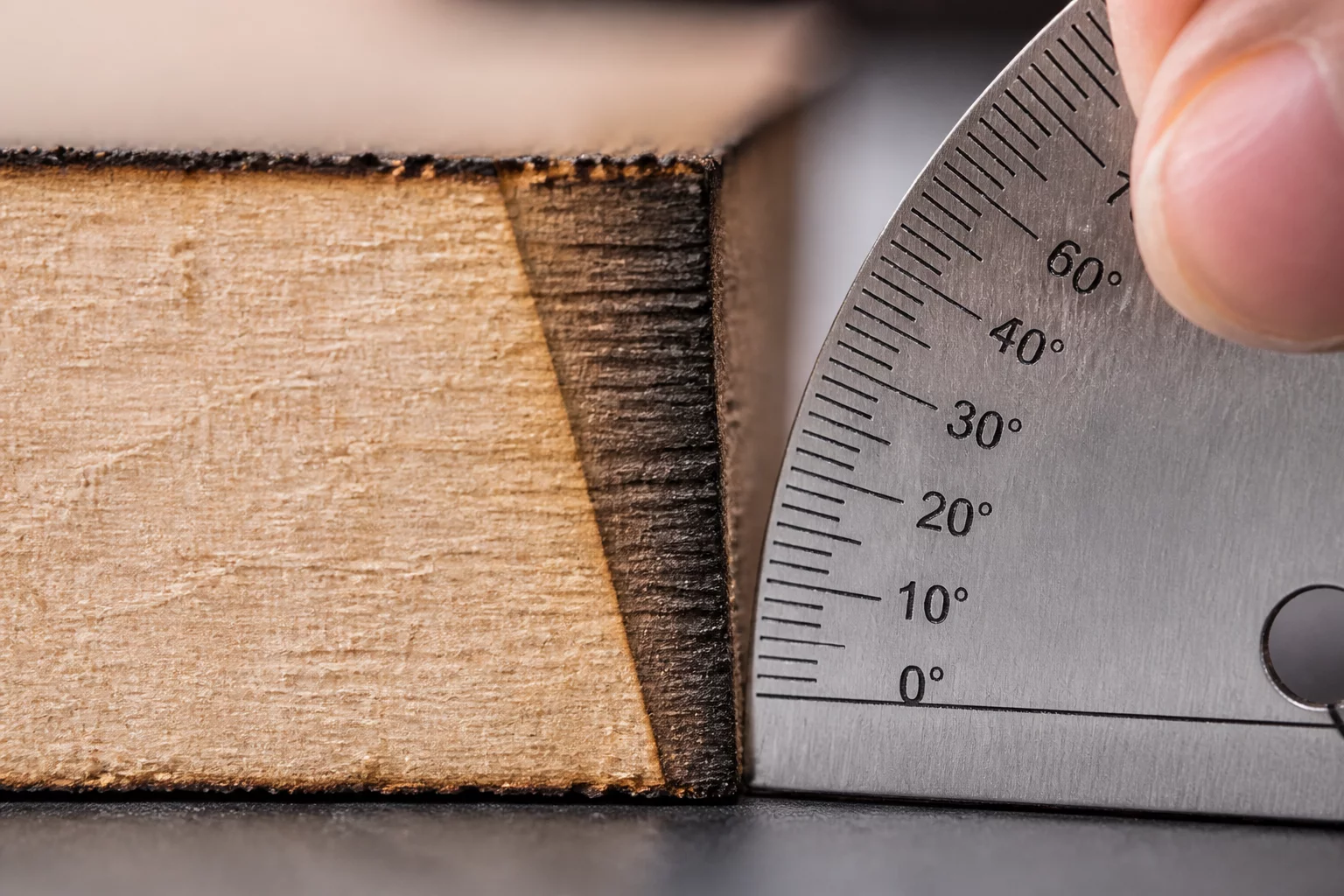
This uneven focal positioning distorts orthogonal slot geometry, causing top-surface slot widening while bottom tabs remain undersized. Even when LightBurn kerf offsets are perfectly dialed on a calibrated test coupon, cutting across a bowed sheet produces inconsistent friction: tight press fits at anchored hold-down points become loose, rattling joints near unsupported warped edges.
Core Protocols for Stabilizing Moisture and Warp Variables
- 01
Acclimate Raw Sheets Inside the Cutting Room
Store plywood and wood composites flat inside the laser workshop for at least 48 hours prior to cutting, equalizing moisture levels with the operational ambient climate.
- 02
Deploy Low-Profile Honeycomb Hold-Down Pins
Fasten bowed stock firmly against the honeycomb grid using perimeter and interior friction pins to keep Z-height focal distance within ±0.15 mm across all cutting paths.
- 03
Measure Caliper Thickness at Five Sheet Locations
Check material thickness across all four corners and the geometric center before defining slot widths, accounting for hygroscopic swelling across the grain.
- 04
Split Longitudinal Cuts to Relieve Internal Grain Tension
Release internal stress within warped panels by sequencing inner slots before outer perimeter cuts, preventing sheet spring-back during active beam passes.
Practical Summary & Field Rules
Environmental humidity directly influences both physical stock dimensions and laser optical delivery. Mitigating these shifts requires proactive mechanical flattening and localized coupon verification.
- Substrate bow exceeding 1.0 mm alters beam spot diameter and produces an irregular V-shaped kerf taper.
- Relative humidity fluctuations above 15% demand recalibration of friction-fit slot widths.
- Hold-down pinning eliminates focal drift without requiring custom focal tracking hardware.
Compensating LightBurn Kerf on Hygroscopic Stocks
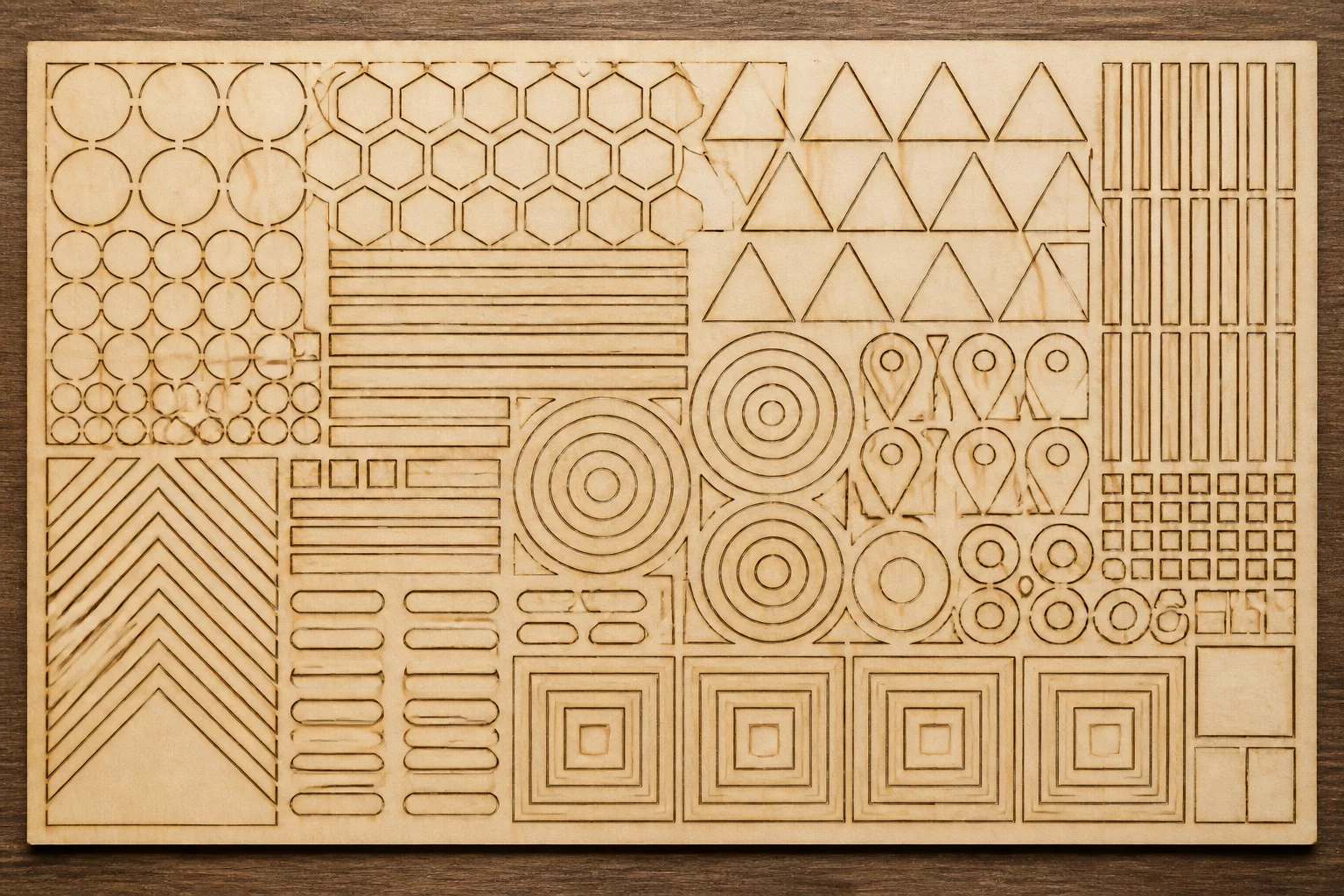
When dealing with high-humidity batches, perform a slot coupon test at the most elevated point of the pinned sheet. Enter the measured beam loss directly into the LightBurn layer kerf offset rather than altering vector drawings manually. Maintaining a consistent single-point offset preserves DXF geometry while counteracting localized material expansion.
For critical press-fit assemblies where post-cut drying could loosen tabs, apply an additional 0.02 mm interference offset. As finished components lose moisture in dry indoor environments, the joint will tighten naturally rather than loosen over time.

Laboratory Comments
No laboratory notes yet. Be the first to leave an empirical observation.
Leave a Laboratory Note
Share technical feedback or empirical observations regarding laser kerf compensation.